Life Beautified helps low-income students fund college through 529 savings plans while building real work skills. Across two phases I went from apprentice, doing the foundational desk research, to lead, running a five-person team, and built the research operations that kept every study moving.

In Phase 1, my secondary research established the problem space: most families have never heard of a 529 plan, and the students who need them most are the least likely to encounter one. In Phase 2, I led a team of five through district scoping, screeners, 8+ in-depth interviews, and five usability tests, and built the end-to-end workflow for recruitment, consent, scheduling, and incentives that made that pace sustainable.
Life Beautified set out to give students from low-income households a way to earn supplementary income toward a 529 college savings account while gaining work experience. Think Rakuten, but the reward goes to college savings instead of a checking account. Its users sit at the intersection of two hard problems: financial literacy and college access.
Before designing anything, the team needed to understand who these students and families actually are, what they know about paying for college, and whether the core premise, earn, save, learn, matched how they live.
Synthesized federal, NCES, and Pew data on low-income students, 529 plans, and the digital divide to frame the problem before recruiting anyone.
Qualified parents in the DMV metro area, household income $30k to $99k, who expect their children to attend college.
Generative sessions via UserInterviews.com, Zoom, and Google Meet, exploring feelings about saving for college, 529 awareness, and openness to affiliate marketing.
Five sessions on the design team's prototypes to check whether the concept was understandable to real families.
A five-person team running studies in parallel needed a shared system, and we didn't have one. With very little budget, I sourced affordable tools and built a standardized way to capture and organize responses, with recruitment, consent, scheduling, and incentives on one tracked pipeline.
Parents worry about affording tuition but hold no concrete savings target. 'I don't think college is getting cheaper anytime soon,' said the father of a 12-year-old.
'Is this the right tool for her? What if she doesn't go to a state school?' asked the mother of 16- and 11-year-olds.
'There just seems to be so many restrictions, so many rules around it.' This mirrors the Phase 1 finding that most families have never heard of a 529.
'My goal is that they can make choices for their education, not based on budget or loans,' said the mother of 9- and 7-year-olds.
'I love that they would gain financial literacy and communication skills.' But parents worried about a child's motivation and the right age, and expected to stay involved.
"My goal is that they can make choices for their education based on what feels right to them, and not based on budget or loans."Parent participant, in-depth interview
Few parents knew the term 'affiliate marketing,' but they instantly recognized the concept through social-media influencers. The product's language had to follow them.
Parents assumed the product worked with stores they already use, especially Amazon, Walmart, and Target, pointing the partnership and onboarding strategy toward familiar names.
Across 20 respondents, younger and higher-educated parents were more familiar with 529s, while older parents and those without higher education were less likely to know one, a clear signal about who needs the most education.
Lead with trust, plain-language education, and visible proof that savings are growing.
Simple charts showing balance trends, because parents asked to see 'what she has earned in a given month' and whether it's 'trending up.'
Badges, Duolingo-style reminders, and light gamification to keep student users engaged, addressing the biggest parental concern.
'Influencer' over 'affiliate marketing,' and everyday brands (Amazon, Walmart, Target) featured first.
Findings revised the personas and user stories and shaped the usability-testing protocol for the design prototypes.

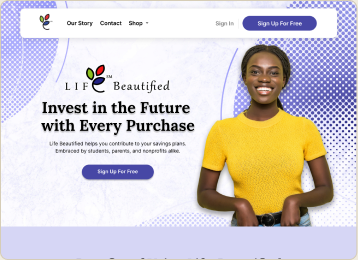
Family-centered homepage

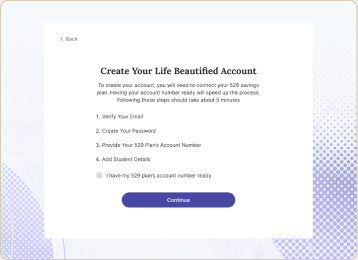
Plain-language 529 onboarding

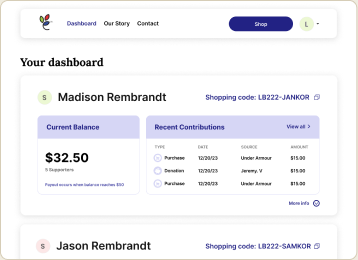
Savings growth made visible
We recruited parents in the DMV area with household incomes between $30k and $99k who expect their children to attend college. That focus was the point, but findings about awareness and trust shouldn't be stretched to other regions or income bands without another look.
The interviews centered on parents, and parents named their child's motivation as their biggest concern. How students themselves respond to earning toward a 529 deserves its own dedicated study.
The link between age, education, and 529 familiarity came from 20 screener respondents. It's a useful signal for targeting education content, and it would need a proper survey before anyone treats it as a market fact.
Five sessions told us families could follow the concept and where the language lost them. Whether they'd sign up, stay engaged, and keep saving is a post-launch question the team still has to answer.
Research operations are what make insight possible at pace. The shared pipeline was the least glamorous thing I built on this project, and it's the first thing I'd rebuild anywhere else: once recruitment, consent, scheduling, and incentives lived in one place, five researchers could run studies in parallel without losing track of participants or findings.
And with a sensitive, vulnerable audience, the most useful finding was a reframe: the student is the user, but the parent is the gatekeeper. Designing for trust between them mattered more than any single feature.